There are more than 600,000 EVs registered in Australia, and a lot of them will spend the summer doing exactly what they do every other week: charging overnight in a garage and never going more than 40km from home. That's fine. Home charging works.
The problem isn't the broader EV owner base, which is growing very quickly. It's the proportion of these owners that will pack the kids and pets in, and head off to see aunts, uncles, and grandparents this summer, up and down the same major routes. The Pacific Highway between Sydney and Brisbane. The Hume between Sydney and Melbourne. The Bruce Highway between Brisbane and Cairns. On a peak holiday day, traffic doesn't spread out. It stacks up at a handful of charging hubs, averaging about three and a half plugs each, and every car that pulls in sits there for 30 to 45 minutes.
That's the failure mode. Not fleet-wide travel. Concurrency. Too many cars wanting the same few plugs in the same few hours.
And the geography is brutal about it. The Bruce Highway runs 1,462km and manages 23.7 high-power† plugs per 100km. The Pacific runs 111 plugs over the same distance. North of Rockhampton, a 200km stretch to Carmila has no high-power charging at all. Even on the busy Pacific Highway, a ~130 km gap exists between Raymond Terrace and Taree. And if you map the ten worst transit towns along these corridors, from Gunning to Bulahdelah to Babinda, every single one of them has zero high-power plugs. Some have nothing at all.
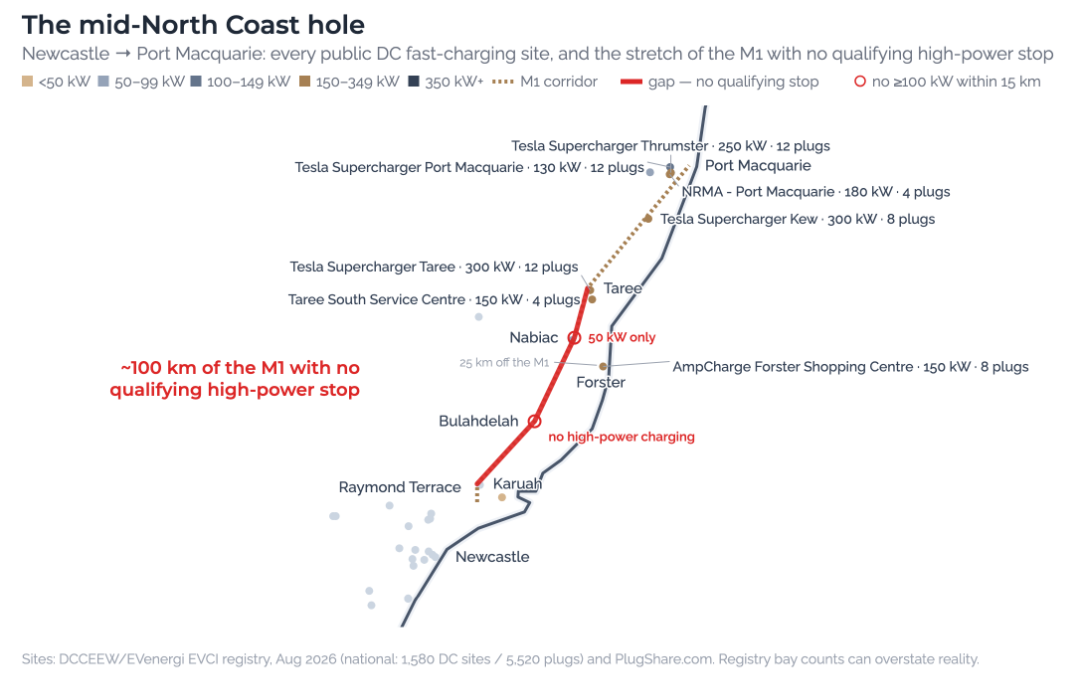
So how did we get here, with more than half a million EVs on the road and peak travel corridors that can barely absorb a busy Thursday? We did it deliberately. But we only did half the job.
Open the floodgates
In November 2022, the (Labor) Commonwealth passed the Electric Car Discount Act and handed every EV under the luxury car tax threshold a 100% exemption from the fringe benefits tax (FBT). Treasury modelled it would cost the budget $205 million over four years. The statutory review found it actually cost about $2.0 billion in its first three years. That's not a rounding error. That's a 10x blowout.
The exemption worked through novated leasing, which lets you salary sacrifice a car through your employer. For someone earning $120,000, a novated lease on a $50,000 EV saved roughly $4,700 a year in tax. Unsurprisingly, people could not get enough of it. Novated leases drove an estimated 40 to 50% of all private EV purchases from 2023 to 2025. This wasn't an organic consumer rush. It was a tax incentive doing what tax incentives do: moving a lot of money very fast. (Full disclosure: I worked at Smart Group from 2023 to 2025).
At the same time, we threw the doors open to supply. The 5% import tariff on EVs came off in July 2022, and we had no mandatory fuel-efficiency standard until the New Vehicle Efficiency Standard started in 2025. EVs were cheap to land, with nothing to meet. Australia became a priority market for Chinese manufacturers overnight. By February 2026, China had overtaken Japan as our single biggest source of new cars for the first time in 28 years.
Read that back. We subsidised demand at ten times the forecast cost, opened the import gate three years before we set an emissions standard, and spent roughly $40 to $60 million on public charging co-investment while we were at it. The cars were always going to come. We made sure of it. The question is what we built to plug them into?
The right thing. Just not the right mix.
Here's where it gets interesting, because the usual complaint is that EV chargers are too slow and too dumb. That's not true anymore. The problem is simpler and harder to fix: there just aren't enough of them.
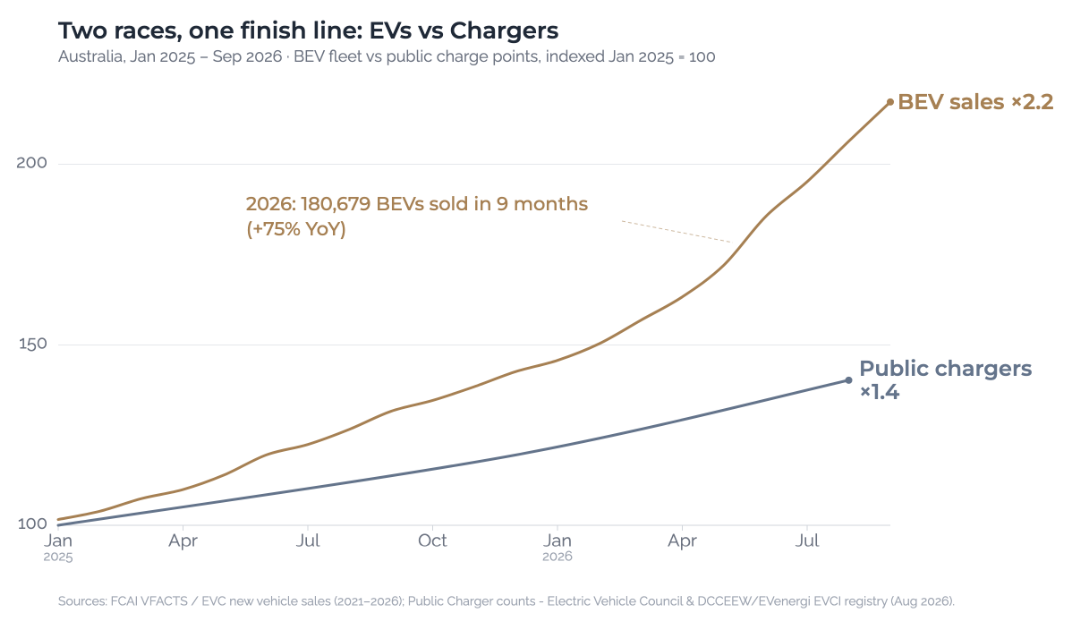
Since 2021, Australia's battery-electric sales have grown roughly twelvefold. Public chargers have grown about 3.4 times. When one line goes up twelve times, and the other goes up only three, the ratio collapses. 5 years ago, there were 7.76 public plugs for every 100 EVs. Today there are 2.25. One plug for every 44 cars.
Now, the network is not building the wrong thing. This is the part the media coverage keeps missing. In 2025 and 2026 to date, four out of every five new fast plug chargers installed were rated at 100kW or above. Across that same period, only 231 new plugs under 50kW went in. The industry has stopped bolting inefficient 50kW units to roadhouses and council chambers, and started building proper 150kW to 350kW hubs. That's the right call. On the open road, a slow charger is almost worse than none, because it occupies a bay without clearing the queue.
Tesla is rolling out its Superchargers at a good rate, but it takes time to get them approved and built - until someone comes along and steals all the valuable copper cables.
The issue is volume. In the nine months to September 2026, Australians bought 180,679 battery EVs, up about 75% on the year before. Over the same stretch, the network added roughly 720 new fast plugs. Do that division yourself. The cars are arriving in the hundreds of thousands and the plugs in the hundreds.
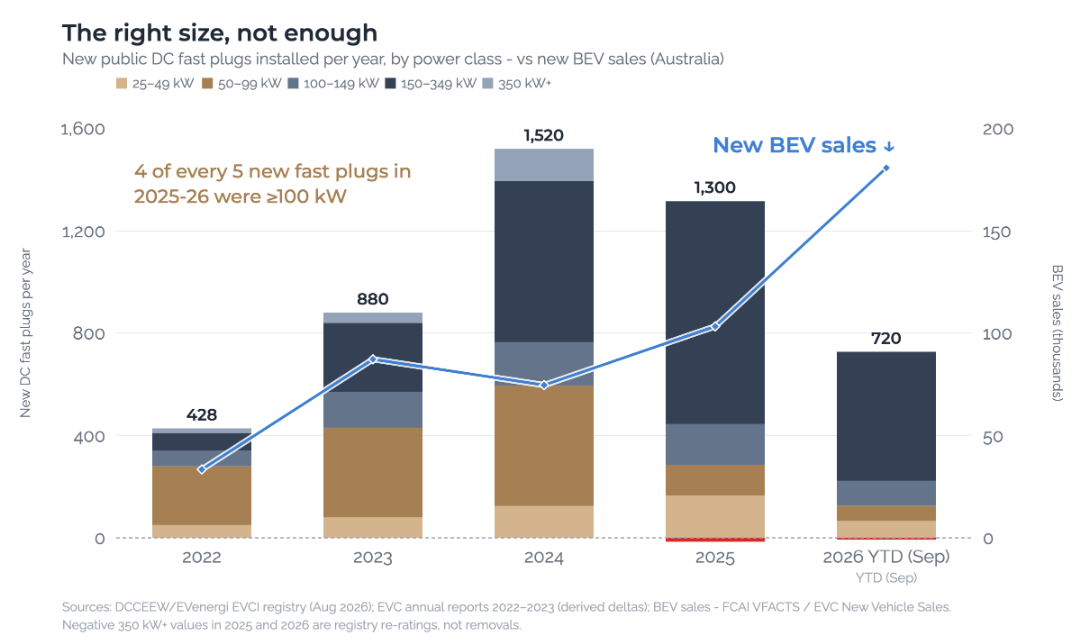
And the sales trajectory is not slowing. Here are the actual FCAI and EVC numbers, not estimates:
| 2021 | 2022 | 2023 | 2024 | 2025 | 2026 (YTD Sept) | |
|---|---|---|---|---|---|---|
| BEV Sales | 5,149 | 33,410 | 87,217 | 74,612 | 103,270 | 180,679 |
| % Increase | - | +549% | +162% | -15% | +39% | +75% |
The dip in 2024 when the state rebates expired is right there in the data. So too is the surge once the market found its feet again. EV sales are compounding. The public EV charger count is crawling.
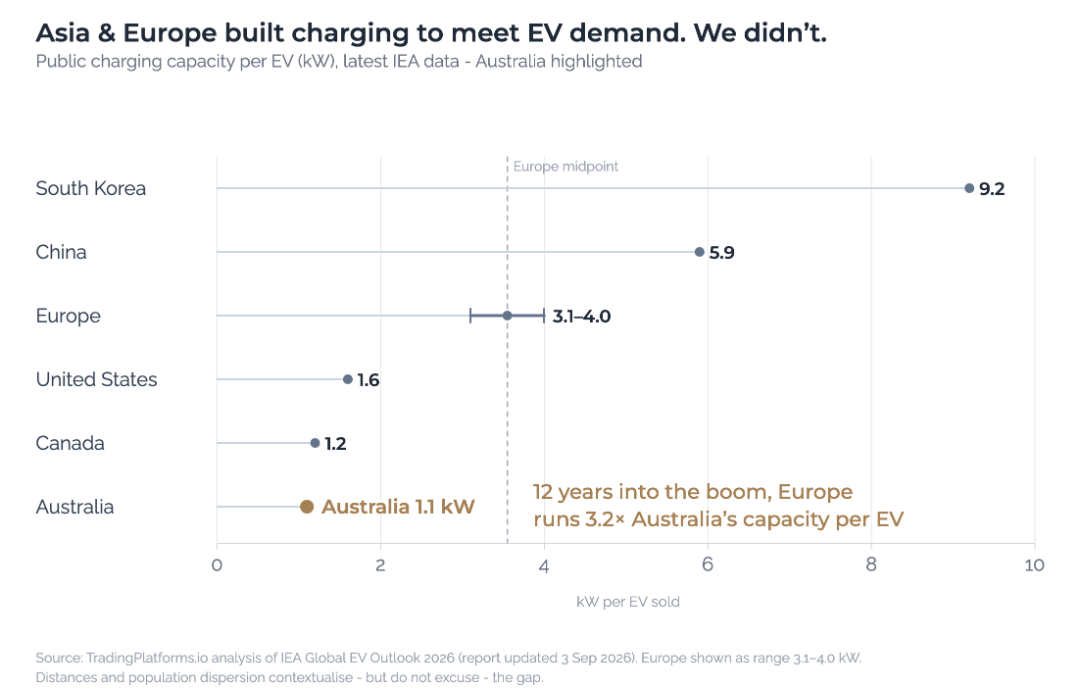
Step back and compare this to the rest of the world, and it's not flattering. On total public charging capacity, Australia sits at 1.1 kilowatts per EV, bottom tier, down with the US at 1.6 and Canada at 1.2. South Korea is at 9.2. China is at 5.9. Europe runs 3 to 4. We are not in the conversation.
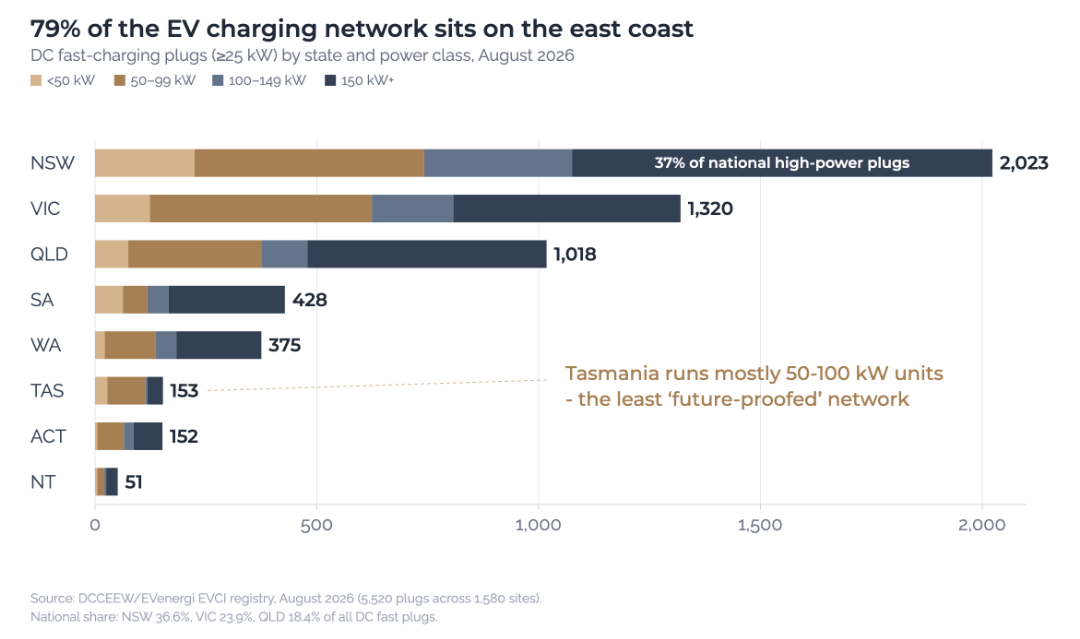
And within Australia, the thin coverage isn't evenly spread. New South Wales, Victoria and Queensland hold 78.9% of all the fast plugs in the country. The east coast has most of what little there is, which is exactly where the holiday corridors are, which sounds like good news until you remember that's also where all the cars are trying to go on the same three days.
The economics nobody is talking about
So why doesn't the market just build more? Chargers make money, right? Plug in, pay 70 cents a kilowatt-hour, and the operator banks the margin. Field of Dreams stuff - "If you build it, they will come".
No. And this is the bit that explains everything above.
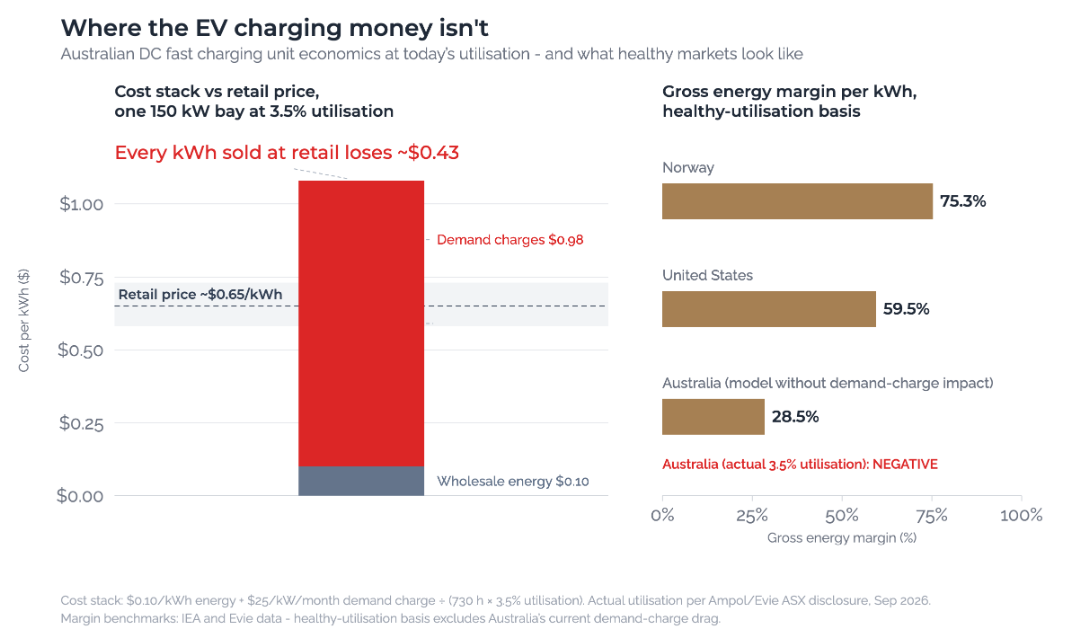
Wholesale electricity is cheap, so the Government keeps telling us. It's currently around 8 to 10 cents per kilowatt-hour (kWh). That was never the problem. The problem is the demand charge. A charging operator connects to the grid as a commercial customer, and commercial customers get billed on their peak draw: $15 to $35 per kilowatt per month, every month, whether anyone shows up or not. Put in a pair of 150kW charging bays, and you're being billed on a 300kW peak rate before you've sold a single electron.
That bill only makes sense if the chargers are busy. Which they aren't. We finally have hard numbers on this, because when Ampol moved to buy Evie Networks, it had to disclose Evie's actual throughput to the ASX. The answer was 117 to 142 kWh per bay, per day. On a 150kW bay that can theoretically deliver 3,600 kWh per day, that's a utilisation rate of 3.3 to 3.9%. The chargers sit idle about 96% of the time.
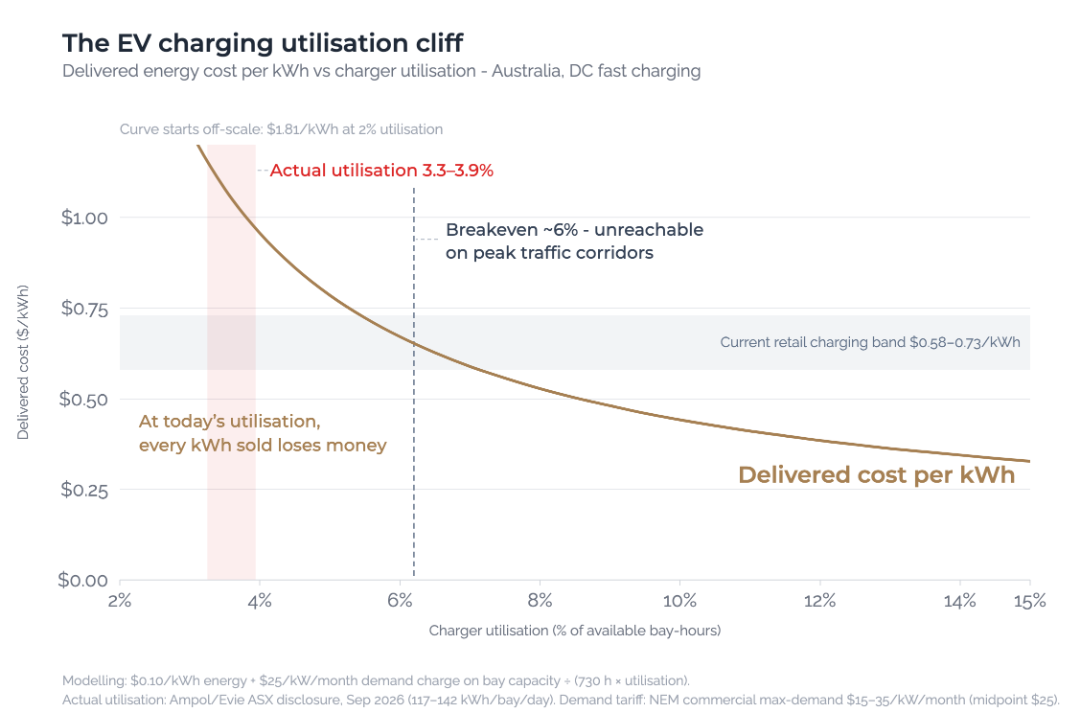
Spread a fixed demand charge across that little throughput and the arithmetic turns ugly fast. The delivered cost of energy for the operator lands somewhere around $0.98 to $1.14 per kilowatt-hour once the demand charge is loaded on. They sell it to you for 58 to 73 cents, because if they charged what it cost, you'd drive home and plug into your off-peak tariff instead. So every kilowatt-hour sold at a public fast charger loses the operator something like 43 cents. They need roughly 6% utilisation to break even, and they're averaging less than 4%.
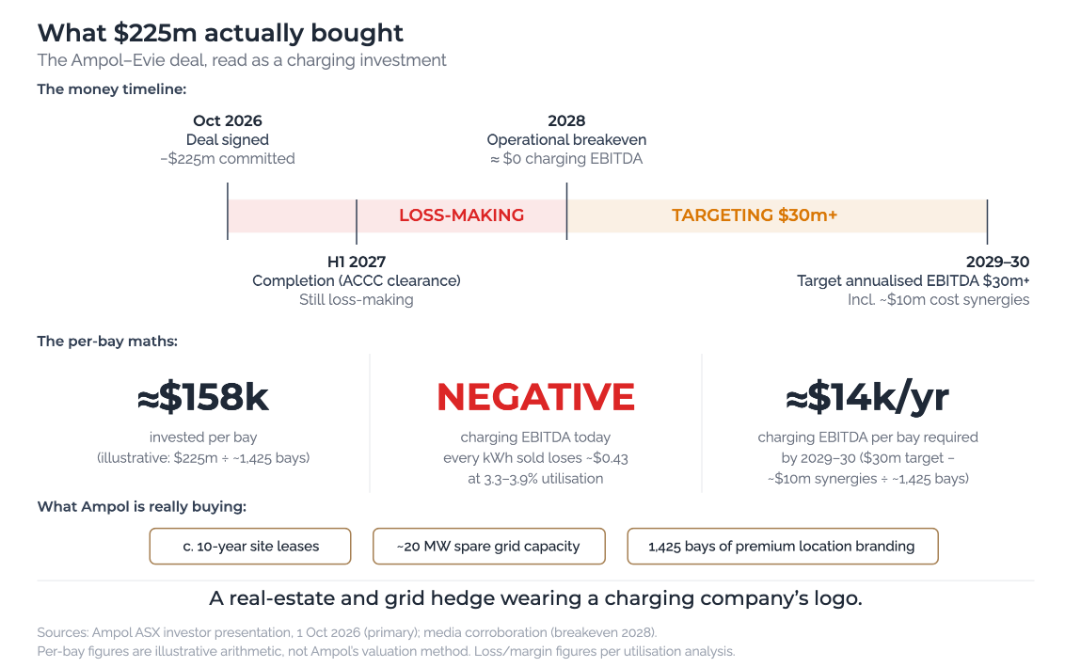
Which brings us back to the Ampol/Evie Networks deal, because it tells you what the smart money actually thinks. Ampol has agreed to buy Evie for $225 million*. That's about $218,000 per charging bay. For a business running at sub-4% utilisation and losing money on every kilowatt-hour, that is a lot of money. Ampol isn't expecting it to pay off soon either. The combined business is targeting $30 million-plus in EBITDA only by around 2029 to 2030, and that target leans on about $10 million in OpEx benefits. Standalone breakeven isn't expected until 2028.
So why pay $225 million for a loss-maker? Because you're not buying a charging business. You're buying 10-year leases on prime real estate and about 20 megawatts of spare grid connection, at a moment when your core products, petrol and diesel, are in structural decline and are 30-50%+ more expensive than they were a year ago. It's a real-estate and grid hedge wearing a charging company's logo. That's a rational move for Ampol. It is also a quiet admission that nobody can currently make public fast charging pay on its own.
That's the whole machine. We (Australians) paid ten times the forecast to put EVs on the road. We let supply flood in before any regulation. We left the chargers to a commercial market that loses money on every session it sells. And the bill for all of that lands, predictably, at the holiday peak, on the roads (and in the pockets) where it hurts most.
So, where does that leave us?
We engineered a top-heavy boom. The (Labor) Commonwealth spent roughly $2 billion pulling EV demand forward through a tax loophole, ten times what it budgeted, while putting a paltry $40 to $60 million into the chargers those cars would need, and then handed the supply side a demand-charge regime designed for factories. One side of the ledger was supercharged. The other was starved and then taxed on its peak draw whether anyone showed up or not. You don't need a conspiracy to explain the result. You just need to look at where the money went. Demand got a subsidy worth billions. Supply got a rounding error. The cars came, exactly as intended. The plugs didn't, unsurprisingly.
The fix is anything but exotic, and other countries have already run the experiment. The single biggest lever is the demand charge. China exempts EV charging from it. South Korea mandates off-peak rates. More than 15 US states have legislated demand-charge 'holidays' for public charging load. Australia classifies a highway charger the same as a supermarket, and it's killing the economics. Reclassify it, and sites that lose 43 cents a kilowatt-hour start to pencil. Second, mandate grid-connection terms for charging the way we mandate them for new housing (gee, where have we heard that before?), so an operator in regional Queensland isn't quoted $1.5 million for a transformer. Third, tie corridor build-out to fleet growth with an actual target: plugs per 100 EVs on the primary travel routes, reported annually, so the 2.25 ratio stops falling. None of this subsidises cars. All of it fixes the half we skipped.
And then there's the blow nobody modelled. The NVES and the FBT exemption were designed for a world where energy prices behaved. Nobody priced in a war across the Strait of Hormuz, the chokepoint that carries about 20% of the world's petroleum liquids. Since the Iran escalations began in February 2026, Australia, which imports more than 90% of its refined fuel, has borne the brunt. Diesel, the fuel of over 232,000 new vehicles this year, including the Ford Everests and Toyota LandCruisers that tow the caravans and trailers and drive the holiday miles, is now averaging $2.85 a litre, up 56.1% in a year and an all-time record past even the 2022 Russia-Ukraine War peak. At regional and rural roadhouses, the exact places the holiday corridors run through, it hit $3.81 a litre, up 77.2%. An EV charged at home, meanwhile, pays about 25 to 30 cents a kilowatt-hour no matter what happens in the Middle East. The running-cost case for electrification has never been stronger, and the infrastructure to exercise it on a road trip has never been thinner.
So the SUV and the EV are two different problems this coming summer, and both will land on the same holiday weekend. If you're driving an EV, the travel routes are not equal, so plan for the one you're on. The Pacific is tight but workable at 111 high-power plugs per 100km, as long as you don't count on the black hole on the mid-North Coast. The Hume is fine until you get south of Goulburn, where a 72km gap and a dead spot at Gunning could catch you out.
The EV charging plugs aren't really the problem this Summer. The queues will be. So, whilst you're sitting there - waiting patiently in your Tesla or cheap Chinese EV - have a good think about the economics of energy in this country, and see if you think the numbers add up.
Sources: IEA Global EV Outlook 2026 / TradingPlatforms.io (Sep 2026); DCCEEW / EVenergi Federal EVCI registry (Aug 2026); FCAI VFACTS and EVC new vehicle sales (to Sep 2026); Treasury FBT statutory review / NRMA (2026); Ampol Limited ASX acquisition release (1 Oct 2026); AEMC / AER network tariff determinations (2024–2026). Fuel prices: ACCC weekly monitoring (9 Oct 2026) and NSW FuelCheck (11 Oct 2026). * Subject to ACCC Approval. † Locations offering over 100kW charging and a minimum of 4 bays - PlugShare.