The Germans have been selling us the same fast SUV for nearly a decade. Big motor, lots of exhaust noise, big screens, big numbers, and a driving experience that's been sanded down until there's nothing left to grip. The Alfa Romeo Stelvio Quadrifoglio QV is the antidote. It's loud, it's flawed, it's not cheap - and it's probably the most engaging high-performance SUV money can buy in Australia right now.
After a week behind the wheel, including a couple of long runs through the Southern Highlands and the usual city running around, I'm convinced this version of the Stelvio is going to be remembered as fondly as the Fiat 126 - long after the last one rolls out of the factory in Cassino.
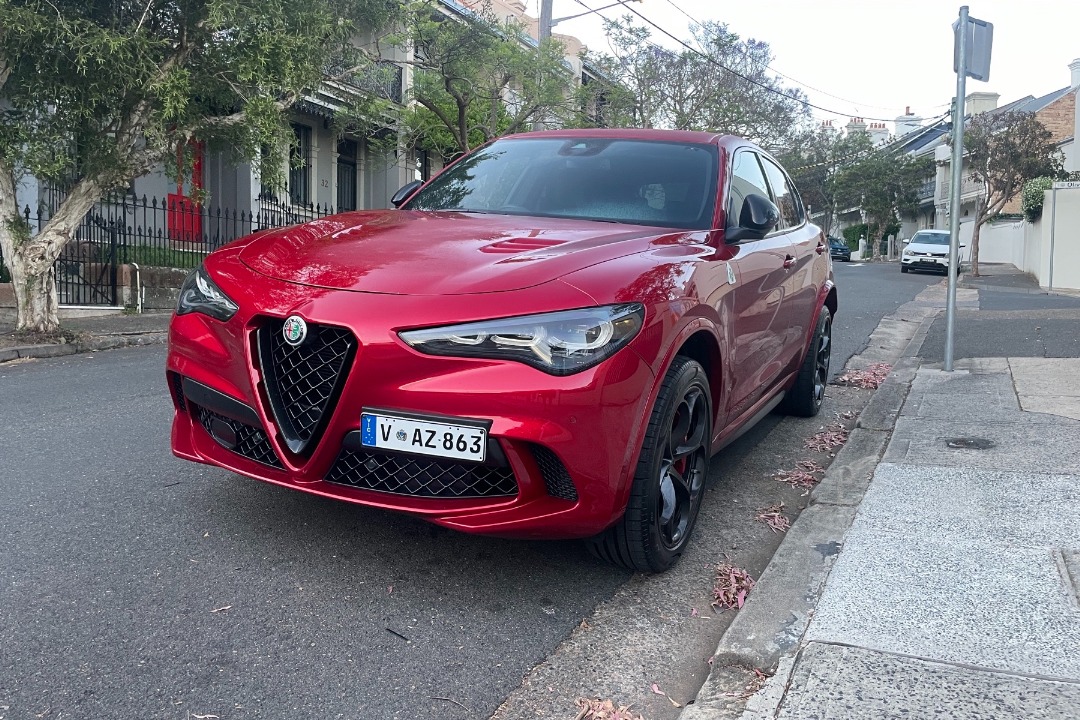
Design & Exterior
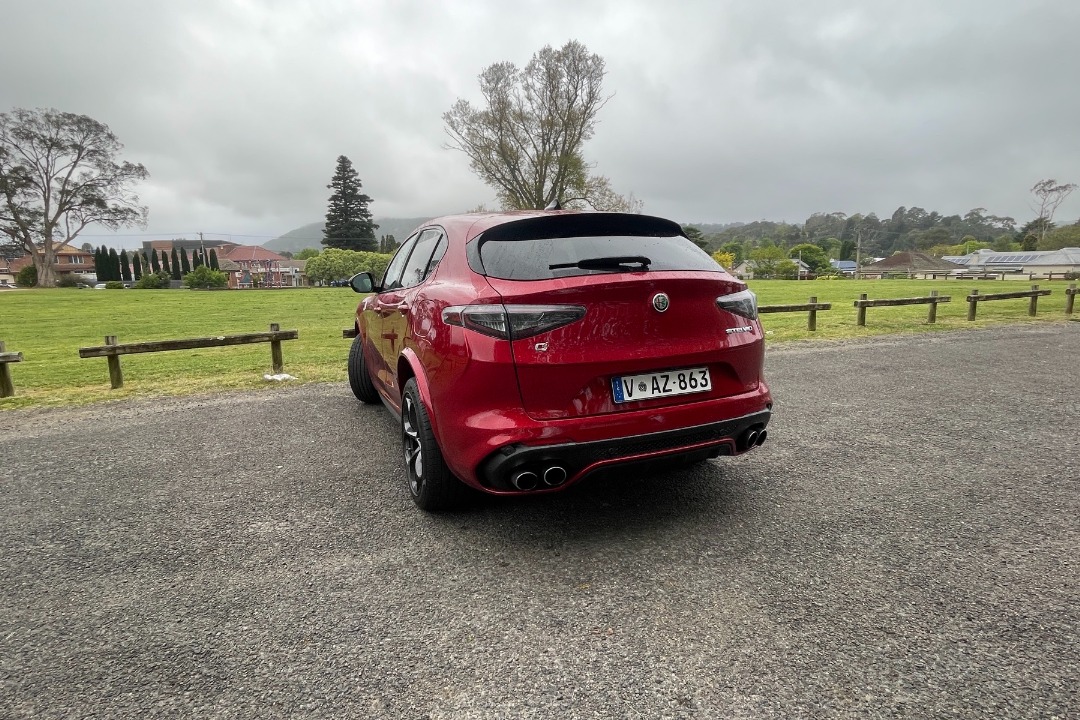
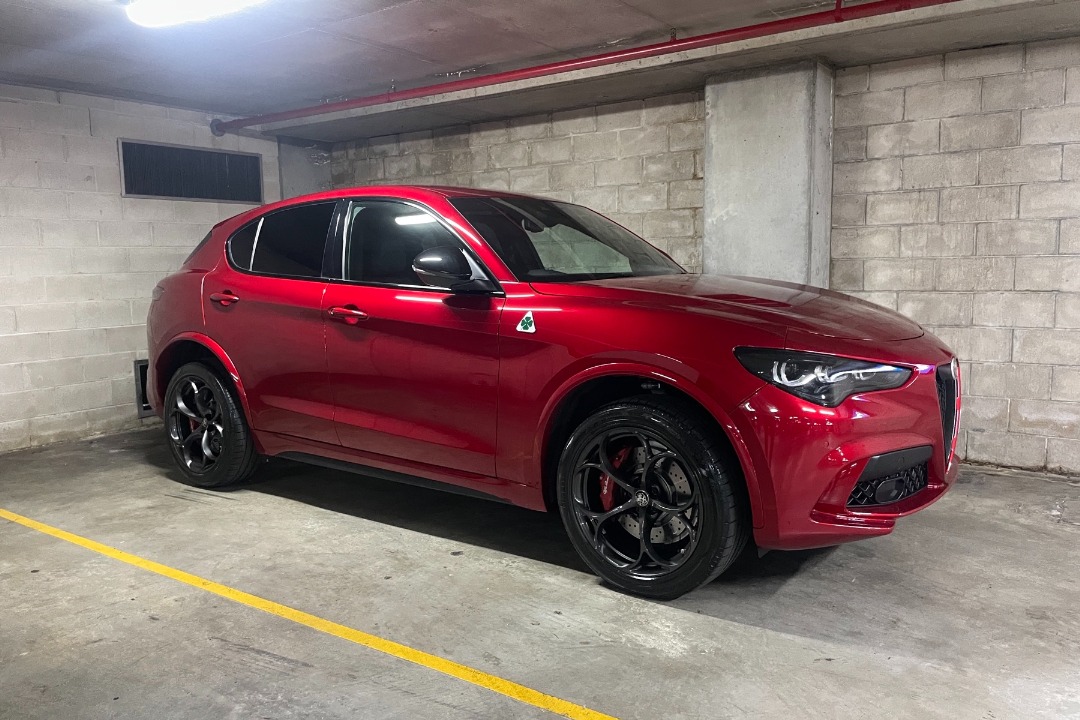
The Stelvio has always looked like an Alfa first and an SUV second, and this Quadrifoglio variant leans hard into that. The wide stance, the iconic trefoil grille, the bonnet bulges and ducts, the carbon trim - it's a properly handsome car from any angle, and it doesn't try to lecture you about aerodynamics or active vents the way the German set does.
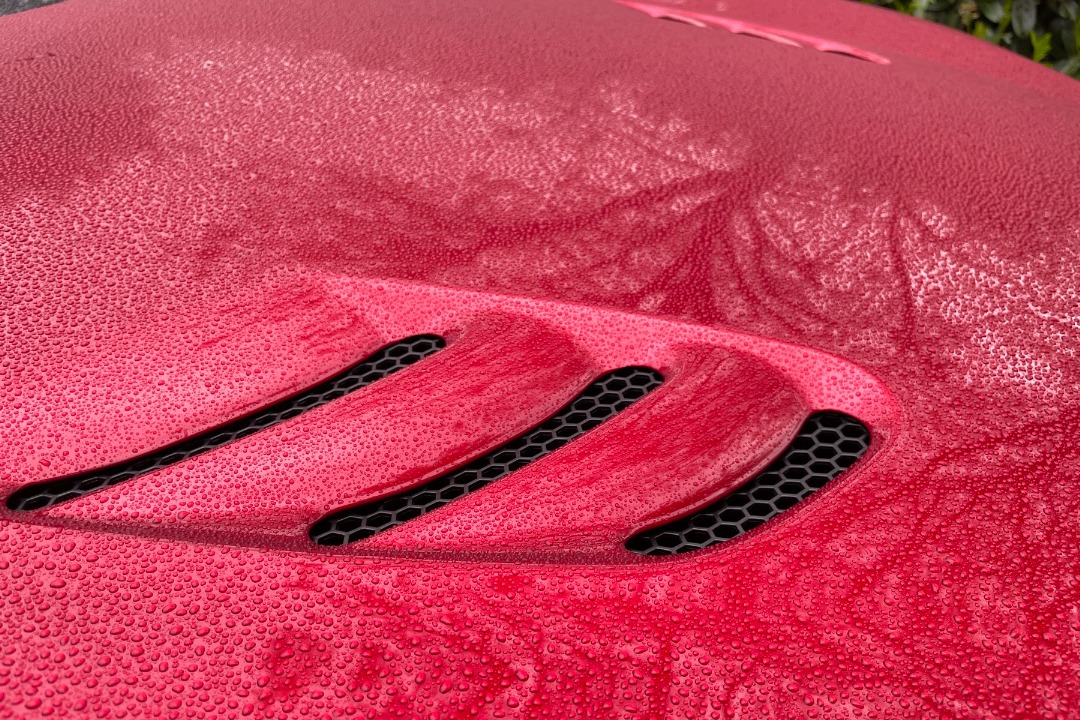
Our test car wore the optional Etna Red paint, and it's worth every cent of the $4,000 it adds to the bill. In sunlight, it's a deep, glassy crimson. Under streetlights at night, it goes near-black with a copper sheen.
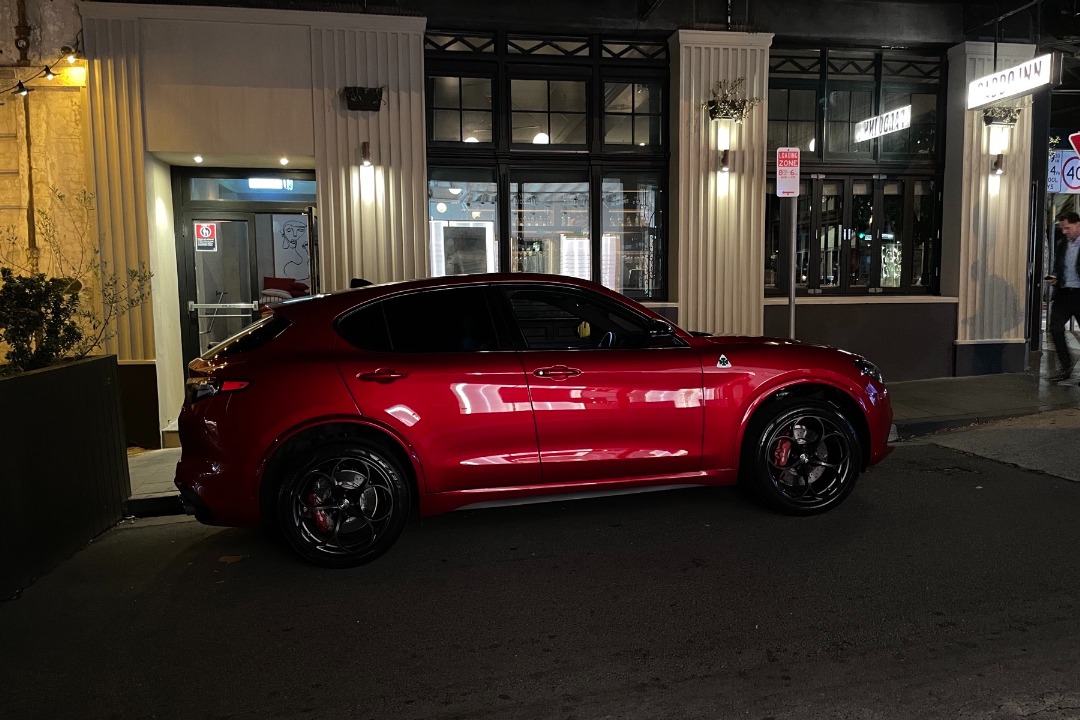
The visual cues that matter:
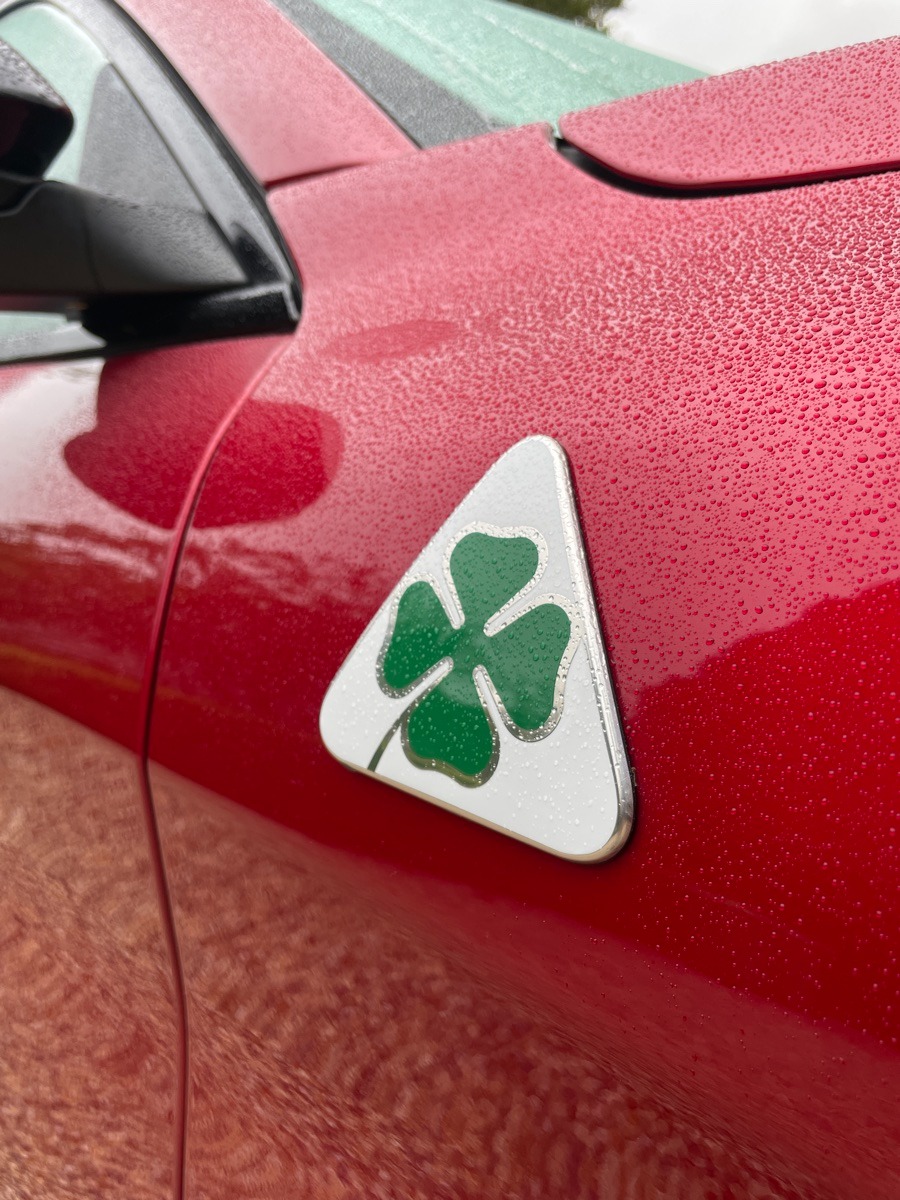
- The signature Quadrifoglio (four-leaf clover) badge on the front guards - earned on track, not bought in a brochure.
- Subtle carbon fibre detailing on the mirror caps, splitter and rear diffuser - tasteful, not yobbo.
- A neat quad layout central exhaust that hints at what's about to happen when you press the throttle.
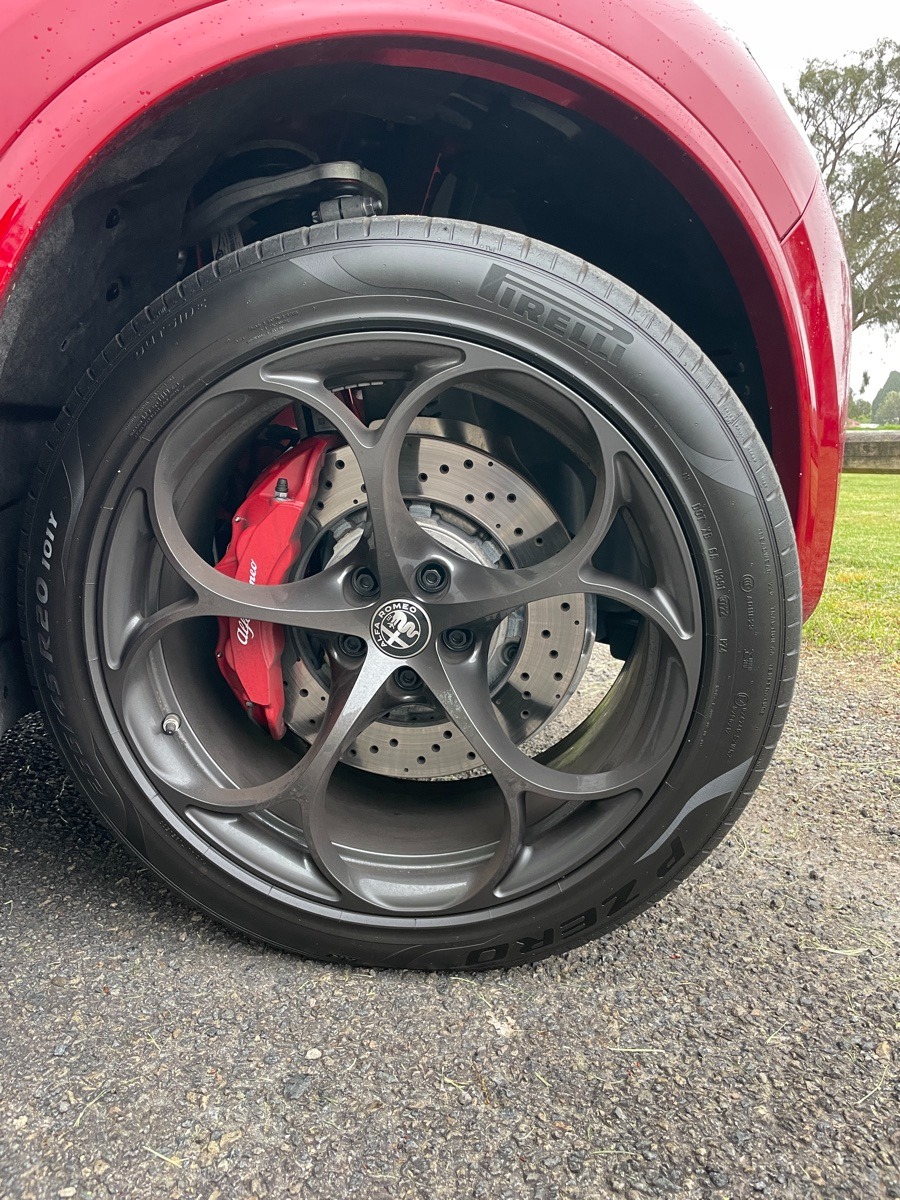
- Forged alloys that fill the arches properly without looking like they came off a JDM tuner build.
Compared to an X3 M Competition or a GLC 63, the Stelvio looks like it was drawn by humans rather than optimised by a wind tunnel committee. Some buyers will think it's old-school. I think it's a thing of beauty.
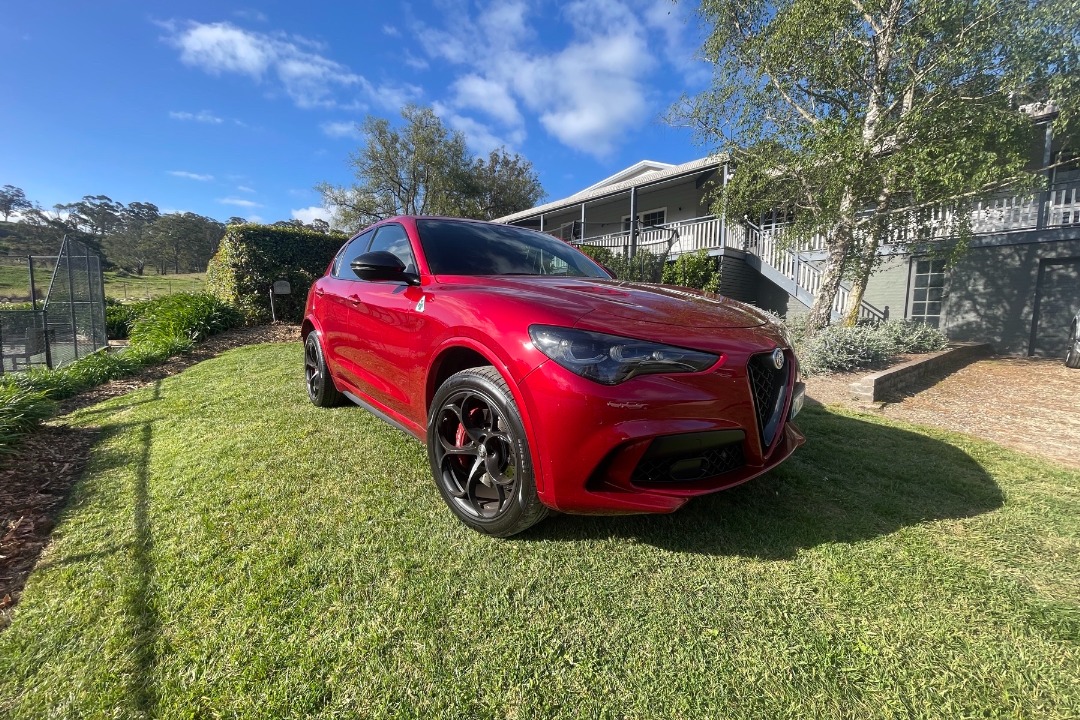
Interior & Technology
Inside, the Stelvio QV is comfortable, well-appointed, and - if we're honest - a generation or so behind the Germans on screen real estate and software polish. That's OK.
The full-leather electric sports seats for the driver and front passenger are excellent. Supportive in the bolsters, soft where it counts, and trimmed in proper hide rather than the synthetic stuff that's quietly taken over most premium cabins. The one oddity are the headrests - boxy, flat and a bit too far forward for taller drivers. You get used to it, but it's a curious miss in a car that otherwise gets the ergonomics right - for Italians.
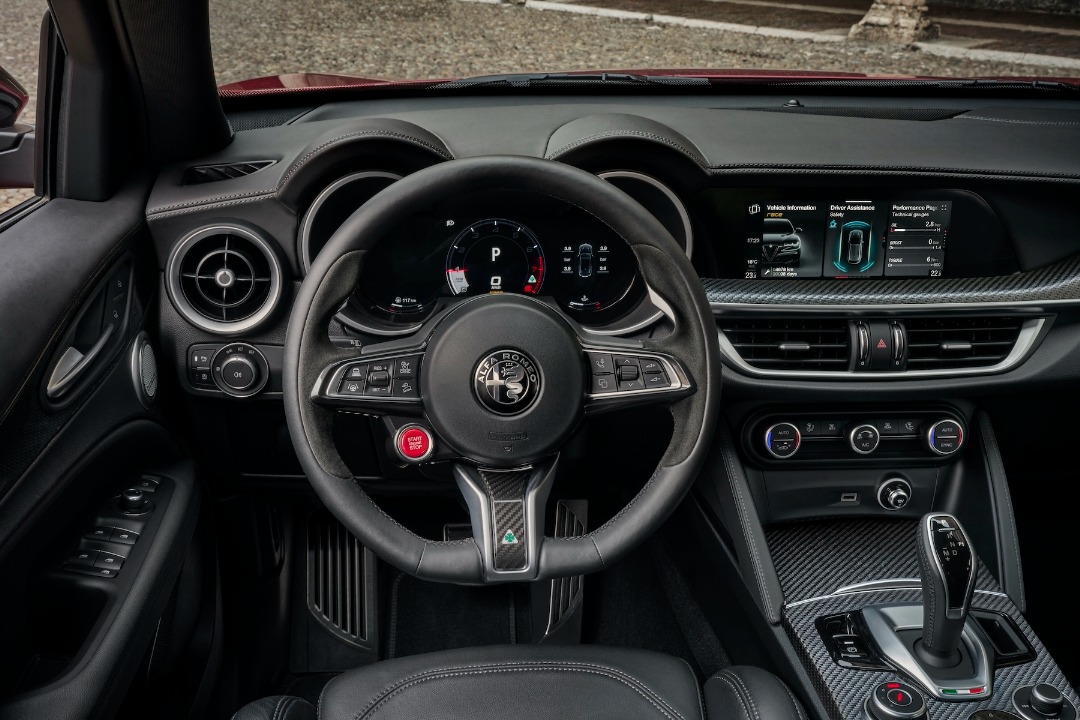
The layout is the proper Italian sports-car-in-an-SUV recipe:
- Four-seat layout that will carry five at a pinch, with usable rear legroom and a flat-ish bench.
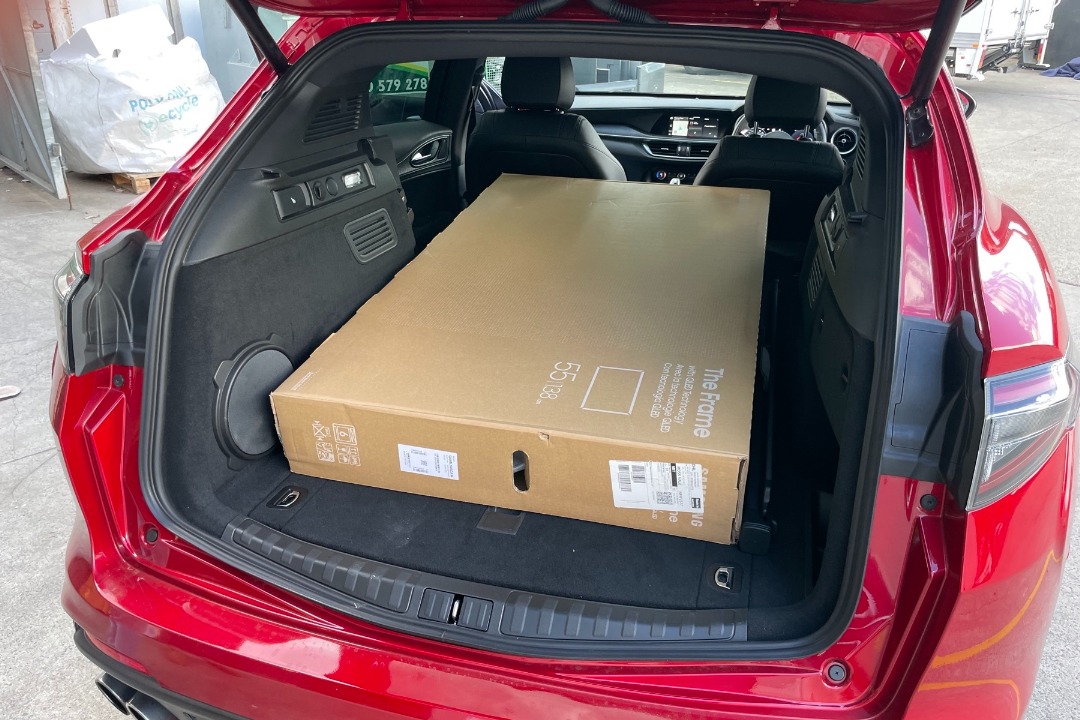
- Boot space is genuinely useful - we managed a weekend's luggage and a full set of golf clubs without playing Tetris. Fold the rear seats down and a 55-inch TV slides in without drama.
- Aluminium shift paddles behind the wheel - more on these later.
- A Harman Kardon 900W sound system with 14 speakers that does justice to everything from Van Morrison to Massive Attack.
- Wireless Apple CarPlay and Android Auto that, mercifully, just work.
The infotainment is the area where you notice the Stelvio's age most. The graphics are last-generation, the menus take a click or two more than they should, and there's no big slab of OLED dominating the dash. If you've come from a current-spec Audi or Mercedes, it'll feel basic. If you've come from anything pre-2020, it'll feel fine. Personally, I prefer the lower screen real estate - it puts your eyes back on the road where they belong.
Build quality is good, not great. There are a few hard plastics down low and the odd squeak over rough surfaces, but the bits you touch every day - wheel, seats, gear selector, paddles - all feel properly engineered.
Performance & Driving Experience
This is where the Stelvio QV stops being an interesting choice and becomes a genuinely important one.
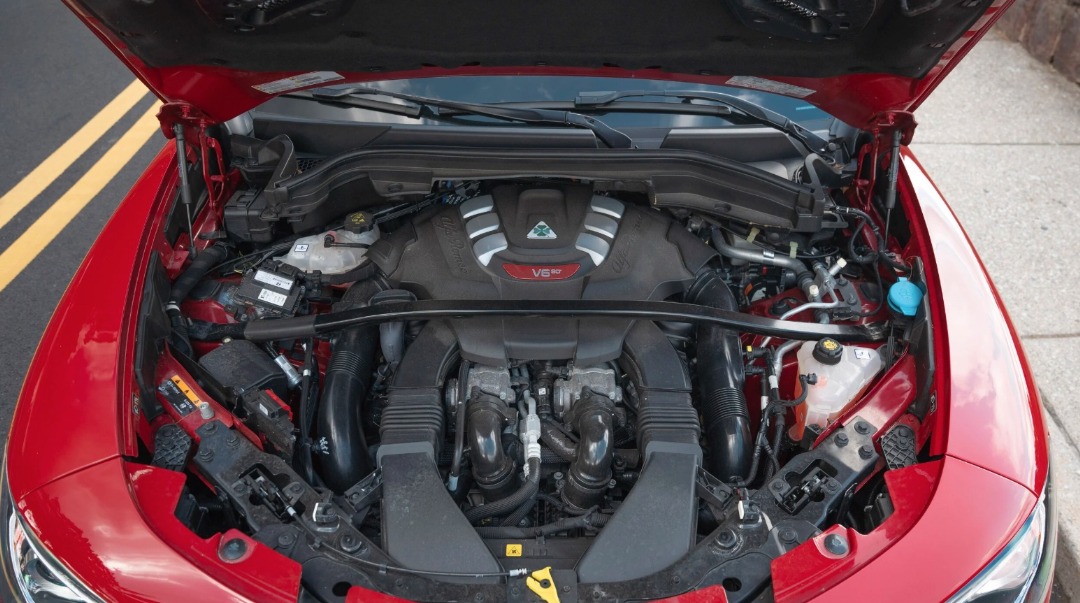
Under the bonnet sits a 2.9-litre twin-turbo V6 producing just over 375kW (500HP), drinking through forged internals and exhaling through that quad-pipe setup. It's the same architecture as the Giulia QV's engine - itself loosely related to a certain Ferrari V8 - and it sounds like nothing else in the segment.
The numbers are familiar performance-SUV fare: 0-100km/h in around 3.8 seconds, top speed comfortably north of 280km/h. What the numbers don't tell you is how the car delivers them.
- The engine is a peach. Linear, urgent, and properly characterful from 2,000rpm right up to the redline.
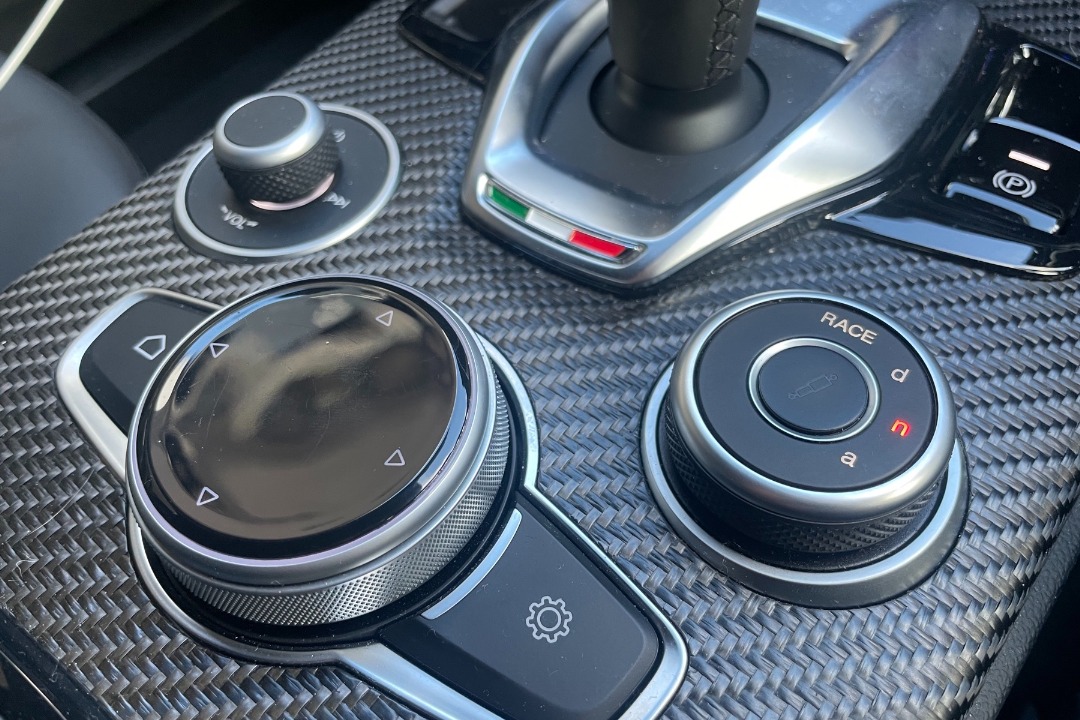
- Throttle response in Race mode is sharp without being twitchy. The exhaust flap opens, and the whole car wakes up.
- The new mechanical limited-slip differential combined with the Q4 all-wheel drive system means traction out of a tight corner is genuinely astonishing for a large SUV.
- Weight distribution is a near-perfect 50/50, which you feel the first time you load the front end into a fast sweeper.
- The QV Active Suspension handles undulations and surface changes far better than any air-sprung German rival, particularly mid-corner.
- Brembo brakes retard 2.5 tonnes of fast-moving Italian metal with composure - we never got close to fade, even on a spirited Sunday morning coffee run. Optional carbon ceramics are available for the truly committed.
- A strut brace under the bonnet keeps the front end honest when you're really pushing on.
The steering deserves its own paragraph. It is - by some distance - the best steering in any current SUV. Fast, accurate, and beautifully weighted, with actual feedback rather than the synthetic "feel" most rivals serve up. If you blindfolded a keen driver and dropped them in the Stelvio QV, they wouldn't guess they were in an SUV at all.
Where the Stelvio QV falls short
It would be dishonest to call this car perfect, because it isn't.
- The 8-speed automatic has too many ratios for around-town work. Below 60km/h it's constantly hunting for another gear, and you can feel it shuffle even when you don't want it to. In Race mode with the paddles it's sublime - the rest of the time it's way too busy.
- Adaptive cruise control is genuinely poor on winding roads. It panics on corners, brakes when it shouldn't, and generally makes the car feel less composed than the driver. Fortunately, a long press of the cruise button disables the radar guidance entirely - and the standard cruise that remains is analogue and excellent.
- The shift paddles are fixed to the steering column rather than the wheel itself. They look beautiful, but mid-corner you'll occasionally grab nothing but air. Phantom upshifts and downshifts happen more than they should. It's typically Italian - charming and frustrating.
- Fuel consumption is not a strong point. We averaged 11.5L/100km over more than 400km of mixed driving. Push it harder, and you'll see worse. The good news? It only takes 98 octane - which, given what you're driving, feels like a small price.
The LED matrix headlights are worth a special mention. The active high-beam on the motorway is one of the finest pieces of lighting engineering I've used in any car at any price. It illuminates everything you need to see and dims around oncoming traffic with surgical precision.
Safety
The Stelvio QV carries a five-star ANCAP safety rating and arrives with the active and passive systems you'd expect at this end of the market. There's a sensible suite rather than a try-hard one - which, given how busy some rivals have become on the safety-tech front, is welcome.
Standard kit on the QV includes:
- Level 2 Advanced Driver Assistance Systems (ADAS).
- Active Blind Spot Assist with Rear Cross Traffic Alert.
- Lane Keep Assist.
- Active Cruise Control (with the option to disable the radar guidance for winding roads).
- Driver Behaviour Warning.
- Forward Collision Warning and Autonomous Emergency Braking (AEB).
- Front and rear parking sensors with rear camera and dynamic gridlines.
The interventions are mostly well-judged. Lane Keep Assist is light-handed rather than the over-eager nanny you get in some rivals. AEB has never falsely triggered in our week with the car. The only consistent gripe is the active cruise on twisty country roads.
Value & Verdict
The Stelvio QV is not a cheap car. As tested - Etna Red paint, the usual options - you're looking at comfortably north of $175,000 on the road. That's serious money, and it puts the Alfa squarely up against the BMW X3 M Competition, the Mercedes-AMG GLC 63 S, the Audi SQ5, and the Porsche Macan GTS.
Here's the case for spending it:
- Best-in-class driving dynamics. Nothing in the segment steers like this, handles like this, or responds like this. Nothing.
- A proper twin-turbo V6 at a time when most rivals have either dropped cylinders or gone hybrid in the name of compliance.
- Roughty exhaust note - intoxicating in tunnels, unmistakable on a back road.
- Genuine four-seat usability plus a real boot. This isn't a sports car pretending to be an SUV. It's an SUV that happens to drive like a sports car.
- Standout looks that won't have aged in five years the way some current designs already have.
Here's the case against:
- Pricing makes you inhale sharply - $175,000+ on the road is real money, and the options list adds up fast.
- Fuel consumption is what it is. Plan for around 11-13L/100km in real-world use.
- Infotainment is behind the Germans.
- Resale value of high-performance Alfas is historically a mixed story - though the QV variants have held up better than most. A 2021 version with 60,000km on the clock is asking $90K.
Final Take
If you measure cars by spec sheets, the Stelvio Quadrifoglio QV will look like a slightly older proposition next to its German rivals. If you measure them by how they make you feel on a great road on a Sunday morning, there is no contest.
This is one of the last truly emotional, properly engineered (for Alfa Romeo), petrol-powered performance SUVs we'll ever see. The next generation will be electrified, heavy, faster on paper, and almost certainly less involving. The 2025 Stelvio QV is the car keen drivers will look back on in ten years and quietly regret not buying.
For anyone with the budget and the desire to drive something with genuine character rather than another beige-with-a-bodykit performance SUV - get to a dealer, find a winding road, and decide for yourself. I think you'll know within the first five minutes.